



D2-80 duplex stainless steel screws are an advanced type of fastener known for their exceptional strength, durability, and corrosion resistance. This material, a blend of austenitic and ferritic stainless steel, offers superior performance compared to traditional stainless steels like 304 and 316. This article provides a comprehensive overview of D2-80 duplex stainless steel screws, detailing their material characteristics, benefits, and wide range of applications.
Material Characteristics
1. Corrosion Resistance
One of the standout features of D2-80 duplex stainless steel is its remarkable resistance to corrosion. The combination of austenitic and ferritic phases, along with the presence of nitrogen, enhances its ability to withstand various forms of corrosion, including pitting, crevice corrosion, and stress corrosion cracking. D2-80 exhibits a pitting resistance equivalent number (PREN) significantly higher than that of 304 stainless steel, indicating its superior performance in corrosive environments.
2. Mechanical Strength
D2-80 duplex stainless steel screws possess high tensile and yield strength, making them ideal for applications requiring robust mechanical properties. The typical tensile strength exceeds 800 MPa, and the yield strength is also significantly higher than that of 304 stainless steel. This strength ensures the screws can handle heavy loads and stresses without deformation or failure.
3. Weldability
Despite their high strength, D2-80 screws maintain excellent weldability. They can be welded using most conventional welding methods, except for autogenous welding processes like laser or plasma welding. This versatility in welding makes them suitable for various manufacturing and assembly processes.
Benefits
- High Corrosion Resistance: Suitable for harsh environments, reducing the need for frequent replacements and maintenance.
- Superior Strength: Capable of withstanding high stress and load conditions, enhancing the reliability and safety of the structures they are used in.
- Cost-Effective: Compared to high-nickel stainless steels like 2205, D2-80 is more economical while still offering excellent performance.
- Versatility: Usable in a wide range of applications due to their combination of strength, corrosion resistance, and weldability.
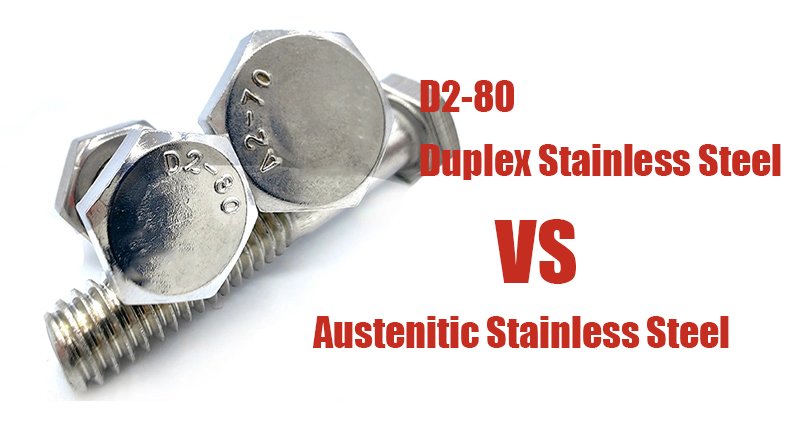
Comprehensive Comparison between D2-80 Duplex Stainless Steel and Austenitic Stainless Steel
D2-80 duplex stainless steel screws are known for their exceptional strength, durability, and corrosion resistance. This material, a blend of austenitic and ferritic stainless steel, offers superior performance compared to traditional austenitic stainless steels like 304 and 316. This article provides a comprehensive comparison between D2-80 duplex stainless steel and austenitic stainless steel based on chemical composition, mechanical properties, corrosion resistance, cost-effectiveness, and applications.
Chemical Composition
The chemical composition of stainless steel significantly influences its properties. The table below highlights the differences between D2-80 duplex stainless steel and common austenitic stainless steels like 304 and 316:
| Element | D2-80 Duplex Stainless Steel | 304 Austenitic Stainless Steel | 316 Austenitic Stainless Steel |
|---|---|---|---|
| C | ≤ 0.040% | ≤ 0.08% | ≤ 0.08% |
| Si | ≤ 1.0% | ≤ 1.0% | ≤ 1.0% |
| Mn | ≤ 6.0% | ≤ 2.0% | ≤ 2.0% |
| P | ≤ 0.040% | ≤ 0.045% | ≤ 0.045% |
| S | ≤ 0.030% | ≤ 0.03% | ≤ 0.03% |
| Cr | 19.0-24.0% | 18.0-20.0% | 16.0-18.0% |
| Mo | 0.1-1.0% | – | 2.0-3.0% |
| Ni | 1.5-5.5% | 8.0-10.5% | 10.0-14.0% |
| Cu | ≤ 3.0% | – | – |
| N | 0.05-0.20% | – | – |
The D2-80 duplex stainless steel has a balanced composition of ferritic and austenitic phases, which contributes to its enhanced strength and corrosion resistance.
Mechanical Properties
D2-80 duplex stainless steel exhibits superior mechanical properties compared to austenitic stainless steels. The table below presents a comparison of key mechanical properties:
| Property | D2-80 Duplex Stainless Steel | 304 Austenitic Stainless Steel | 316 Austenitic Stainless Steel |
|---|---|---|---|
| Tensile Strength (MPa) | ≥ 800 | 515-750 | 515-750 |
| Yield Strength (MPa) | ≥ 600 | 205-210 | 205-210 |
| Elongation (%) | 25-35 | 40-50 | 40-50 |
| Hardness (HB) | ≤ 290 | ≤ 201 | ≤ 217 |
The D2-80 duplex stainless steel’s higher tensile and yield strengths make it suitable for demanding structural applications, offering significant advantages over 304 and 316 austenitic stainless steels.
Corrosion Resistance
Corrosion resistance is a critical factor in selecting stainless steel for various applications. The D2-80 duplex stainless steel demonstrates excellent resistance to different forms of corrosion, including pitting, crevice, and stress corrosion cracking, outperforming 304 and 316 austenitic stainless steels. The PREN (Pitting Resistance Equivalent Number) is a commonly used indicator of corrosion resistance:
- D2-80 Duplex Stainless Steel: PREN = Cr + 3.3Mo + 16N
- 304 Austenitic Stainless Steel: PREN ≈ 18-20
- 316 Austenitic Stainless Steel: PREN ≈ 24-26
The higher PREN value of D2-80 indicates superior pitting corrosion resistance compared to 304 and 316 stainless steels.
Cost-Effectiveness
While D2-80 duplex stainless steel generally has a higher initial cost compared to standard austenitic stainless steels, its superior performance can lead to cost savings over time. The enhanced strength and corrosion resistance reduce the need for frequent replacements and maintenance, particularly in harsh environments. Key points include:
- Long-Term Savings: Reduced maintenance and replacement costs due to the material’s durability and resistance to wear and corrosion.
- Material Efficiency: Higher strength-to-weight ratio allows for the use of thinner material, potentially reducing overall material costs in certain applications.
- Operational Efficiency: Increased reliability and lifespan of components, leading to fewer operational disruptions and associated costs.

Applications
Due to its enhanced mechanical and corrosion resistance properties, D2-80 duplex stainless steel is preferred in various industries, including:
- Construction: Structural components and reinforcements
- Petrochemical: Piping systems and pressure vessels
- Marine: Shipbuilding and offshore platforms
- Energy: Renewable energy structures such as wind turbines
In contrast, 304 and 316 austenitic stainless steels are widely used in less demanding environments, including food processing, chemical processing, and medical devices.
Conclusion
D2-80 duplex stainless steel offers a balanced combination of high strength, excellent corrosion resistance, and economic benefits, making it a superior choice over traditional austenitic stainless steels like 304 and 316 in many applications. Its unique properties provide significant advantages in demanding environments, ensuring long-term performance and reliability.
As a leading manufacturer of fasteners, FINEX is well-equipped to supply high-quality D2-80 duplex stainless steel products, tailored to meet the specific needs of our customers across various industries. By choosing FINEX, you gain access to top-tier products that stand up to the most challenging conditions, backed by our commitment to excellence and customer satisfaction. Contact us today to learn more about how our D2-80 duplex stainless steel solutions can enhance your projects.