


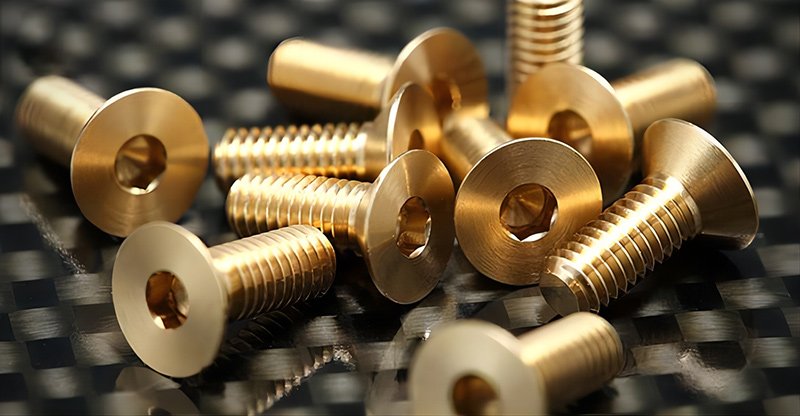
Screws may not be a topic that garners much attention in our daily lives, but they play a crucial role. Screws are used to secure objects together, whether it’s furniture, machinery, or structural components in construction. Today, we will delve into a specific type of screw known as the countersunk screw and explore its importance and advantages in various applications.
Table of contents
- The Basics of Countersunk Screws
- Common material for countersunk screws
- The difference between countersunk screws with coarse thread and fine thread:
- Manufacturing process of countersunk screws
- Applications of Countersunk Screws
- Advantages of Countersunk Screws
The Basics of Countersunk Screws
Countersunk screws, sometimes referred to as flush screws or flat-head screws, have a distinct feature: their heads are designed to be tapered or flat so that they can be embedded into the surface of the workpiece during installation, without protruding. This design allows countersunk screws to provide a smooth, even appearance when connecting two surfaces and without obstructing movement or contact with other objects.

Common Material for Countersunk Screws
The commonly used countersunk screw materials are usually carbon steel, stainless steel and copper:
Carbon steel is one of the most common countersunk screw materials, they have good strength and durability, and the cost is low, easy to process and manufacture. It is commonly used in general applications such as furniture manufacturing and mechanical assembly. However, carbon steel countersunk screws are prone to rust and may require anti-corrosion treatment.
In order to solve the problem of easy rust, customers usually choose stainless steel countersunk screws, usually using stainless steel 304,316. Stainless steels have excellent corrosion resistance, they perform well in wet or corrosive environments and do not require additional anti-corrosion treatment. It is often used in special environments such as outdoor, Marine and food processing. However, compared with carbon steel screws, the cost will be higher
The last one is copper countersunk screws. Copper countersunk screws have excellent electrical and thermal conductivity and are commonly used in electrical and thermal conductivity applications. They are also resistant to corrosion, but their strength is relatively low and not suitable for occasions where high strength is required.
The difference between countersunk screws with coarse thread and fine thread
Countersunk screw threads can be divided into coarse thread and fine thread, the difference between them mainly lies in the specification, use and performance of the thread. Here are the main differences between them:
Thread Specifications:
Coarse Thread: Coarse thread screws have a larger pitch, meaning the distance between threads is relatively far apart. This allows the screw to be inserted or removed more quickly but provides lower precision. Typically, coarse thread screws have fewer threads per inch.
Fine Thread: Fine thread screws have a smaller pitch, meaning the distance between threads is relatively close together. This allows the screw to provide higher rotational precision but results in slower insertion or removal. Typically, fine thread screws have more threads per inch.
Applications:
Coarse Thread: Coarse thread screws are typically used in applications where rapid installation or disassembly is required, such as woodworking, furniture manufacturing, or some mechanical assemblies.
Fine Thread: Fine thread screws are commonly used in applications that require higher precision and stable connections, such as automotive manufacturing, aerospace industries, or electronic equipment assembly.
Performance:
Coarse Thread: Coarse thread screws offer higher torque transmission capabilities, making them suitable for applications that require greater tightening force.
Fine Thread: Fine thread screws typically provide better resistance to loosening because they offer higher friction, making it more difficult for the screw to self-loosen.
The choice between coarse thread and fine thread depends on the specific requirements of the application. If rapid installation or disassembly is needed and tightening force is not the primary concern, coarse thread screws may be more suitable. If higher precision, resistance to loosening, and stable connections are required, fine thread screws may be a better choice.

Manufacturing process of countersunk screws
The manufacturing process of countersunk screws usually includes cold heading, hot heading and machining. Cold heading is a process by which steel or copper is extruded at room temperature and is suitable for the production of countersunk screws with a diameter of less than or equal to 20mm. Hot upsetting is a process in which steel or copper is extruded at high temperatures and is suitable for the production of countersunk screws with a diameter greater than 20mm. Machining is the process of processing steel or copper through lathes, milling machines and other mechanical equipment, which is suitable for the production of countersunk screws with high precision.
Applications of Countersunk Screws
Countersunk screws find wide-ranging applications in woodworking, metalworking, automotive manufacturing, and the construction industry. Here are some common application examples:
1.Woodworking: In furniture making and woodworking projects, countersunk screws are used to join wooden boards to ensure a flush connection without disrupting the appearance of the wood surface.
2.Metalworking: Countersunk screws are also highly useful in metal structures, such as in automotive manufacturing, where they are used to connect car doors to the body and join mechanical components.
3.Construction: Construction projects often require the use of countersunk screws. For instance, in the installation of curtain walls, these screws ensure a smooth and aesthetically pleasing exterior surface.

Advantages of Countersunk Screws
Why are countersunk screws so popular? Here are some advantages of countersunk screws:
- Aesthetic Appeal: The design of countersunk screws allows them to seamlessly blend into the surface without protruding or detracting from the appearance, making them ideal for applications requiring a polished look.
- Safety: Because the screw heads can be embedded into the surface, they are less likely to be struck or damaged, enhancing the stability and safety of the connection.
- Space Efficiency: Countersunk screws do not require additional clearance or protrusions and can be used in confined spaces, making them suitable for various compact applications.
- Versatility: Countersunk screws can be used to connect different types of materials, including wood, metal, plastic, and more, making them versatile for a wide range of applications.
Conclusion
Countersunk screws represent a simple and elegant fastening solution widely used across various industries and projects. They not only offer robust connections but also provide aesthetic appeal and safety. When choosing fasteners for your project, consider using countersunk screws for a secure and visually appealing connection. Whether in furniture making, metalworking, or construction, countersunk screws can be your ideal choice to ensure both strength and aesthetics in your connections.
FAQ
How do countersunk screws differ from flat head screws?
Countersunk screws and flathead screws are often the same type of screw, both having flat or chamfered heads for flush or recessed installation. These terms can be used interchangeably and may vary depending on the region or industry.
How can I avoid over-tightening countersunk screws or damaging the material?
To prevent over-tightening or material damage, you can use a variable-speed drill and gradually increase the torque while screwing. Additionally, you can use screwdriver bits with pre-set depth or limit the screw’s penetration depth to ensure it goes in as far as needed without causing damage.