


Introduction
Choosing the right material for a flat washer is essential to ensure the longevity and performance of your mechanical assemblies. Flat washers, often overlooked, play a crucial role in load distribution, preventing damage, and maintaining the integrity of bolted connections. In this article, we will explore the various materials used for flat washers, their unique properties, and how to select the best one for your specific application.
Understanding the Flat Washer
A flat washer is a thin, flat, circular piece of metal or plastic with a central hole. It is used to distribute the load of a threaded fastener, such as a bolt or nut. The flat washer serves to prevent wear and tear on the assembly and to provide a smooth bearing surface. The material of the flat washer significantly impacts its performance, durability, and suitability for different environments.
Common Materials for Flat Washers
Flat washers come in a variety of materials, each offering distinct advantages and disadvantages. Here are some of the most common materials used for flat washers:
- Stainless Steel Flat Washers
- Properties: Stainless steel flat washers are known for their excellent corrosion resistance, high strength, and durability. They are non-magnetic and can withstand extreme temperatures.
- Applications: Ideal for use in marine environments, chemical industries, and outdoor applications where exposure to moisture and corrosive substances is common.
- Carbon Steel Flat Washers
- Properties: Carbon steel flat washers are strong and durable, but they are prone to rust and corrosion if not properly coated or treated. They offer high tensile strength and are cost-effective.
- Applications: Suitable for general-purpose applications, automotive industries, and construction where corrosion is not a significant concern.
- Copper Flat Washers
- Properties: Copper flat washers offer excellent electrical conductivity and corrosion resistance. They are softer than steel and can deform under high pressure, providing a good seal.
- Applications: Commonly used in electrical applications, plumbing, and situations requiring a good thermal conductor.
- Brass Flat Washers
- Properties: Brass flat washers combine good corrosion resistance with excellent electrical conductivity. They are aesthetically pleasing and have a low friction coefficient.
- Applications: Used in electrical components, decorative applications, and plumbing fittings.
- Nylon Flat Washers
- Properties: Nylon flat washers are lightweight, non-corrosive, and provide good insulation. They are resistant to a wide range of chemicals and have a low friction coefficient.
- Applications: Ideal for use in electronics, appliances, and situations where metal washers could cause electrical shorts or corrosion.
Choosing the Right Flat Washer Material for Your Application
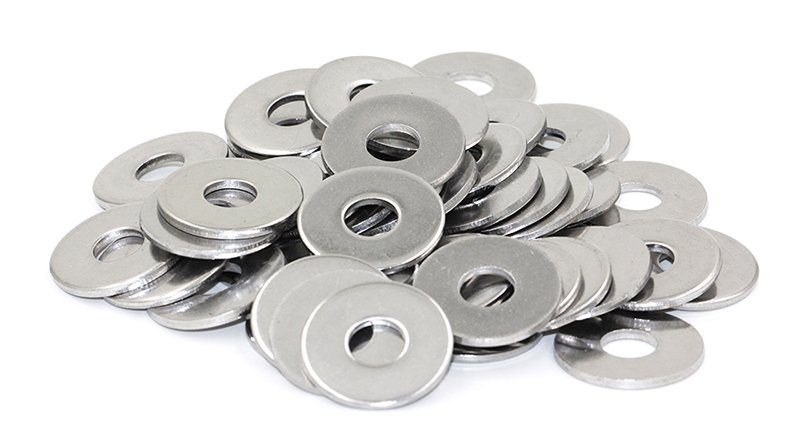
Selecting the appropriate material for your flat washer depends on several factors, including the environment, load requirements, and specific application needs. Here are some considerations to help you make the right choice:
- Environmental Conditions
- For applications exposed to harsh environments, such as marine or chemical industries, stainless steel or copper flat washers are recommended due to their excellent corrosion resistance.
- In dry, indoor environments where corrosion is not an issue, carbon steel flat washers may be suitable and more cost-effective.
- Load and Stress Requirements
- High-load applications require washers with high tensile strength, such as carbon steel or stainless steel flat washers.
- For sealing applications or where a degree of deformation is beneficial, copper or brass flat washers can provide an effective solution.
- Electrical and Thermal Conductivity
- For electrical applications, copper and brass flat washers are ideal due to their excellent conductivity.
- In applications requiring thermal management, such as heat sinks, copper flat washers are preferable.
- Chemical Resistance
- Nylon flat washers are resistant to many chemicals and are suitable for use in environments where exposure to solvents, oils, or other chemicals is expected.
- Stainless steel flat washers also offer good resistance to a wide range of chemicals and are suitable for industrial applications.
Conclusion
Selecting the right material for your flat washer is crucial for ensuring the effectiveness and longevity of your mechanical assemblies. By understanding the properties and applications of different materials, you can make informed decisions that enhance the performance and durability of your projects. Whether you need the corrosion resistance of stainless steel, the electrical conductivity of copper, or the chemical resistance of nylon, there is a flat washer material that meets your specific requirements. Always consider the environmental conditions, load requirements, and application needs when choosing the perfect flat washer material for your project.